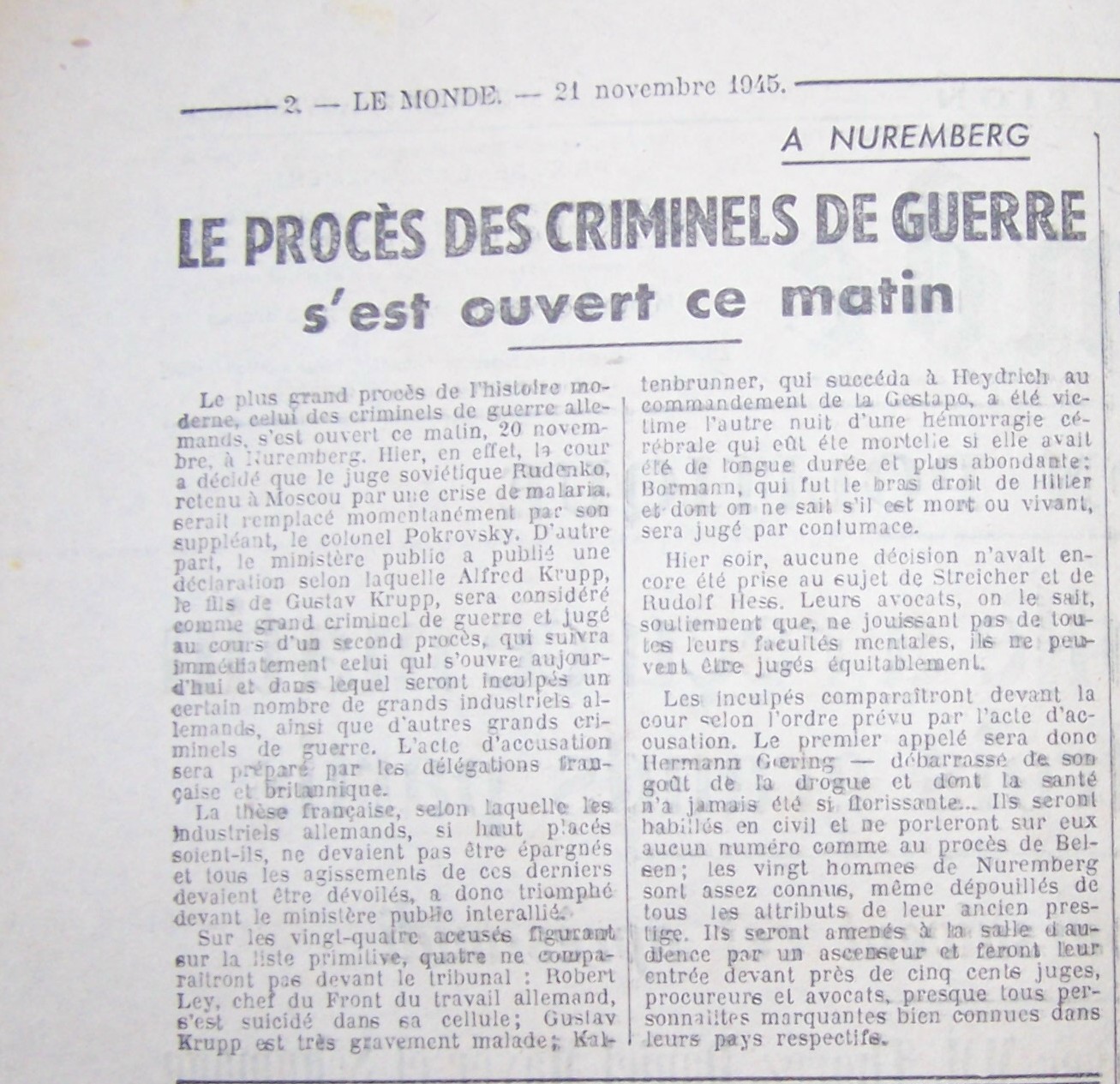
| Source | Le monde. Wednesday 21st Novembre 1945 N°289
Le Monde is a French daily newspaper created by H.Beuve Méry in 1944. Meant to be the reference paper. Evening newspaper dated from the day after.
|
| Event referred to | Beginning of the Nuremberg trial |
| Technological characteristics | None |
| Description of the source | Kind of source :Daily newspaper
origin of the source : Personnal Archives
Language: French translated in English
Copyright issues : Le monde
|
| Contextualisation of the source | At the head of the GPRF, general de Gaulle tries to form a government with the leaders of three big parties : communist, socialist and MRP. France occupies a part of Germany and has a judge : Henri Donnedieu de Vabres- in the court of NUREMBERG, like USSR - The United States and England.
The prisoners in concentration camps, who survived, are back.
France is to be rebuilt, economically.
|
| Interpretation of the source | France is part of the side of the conquerors and takes part in the trial of Nuremberg, which had been decided by USA, USSR and Great Britain.
France asks sentencing for the atrocities committed by the Nazis, especially as regards the French prisoners.
France insisted that the biggest German Industrialists should be also tried in a next trial. The opening of this trial is not the major newspapers. There are two very descriptive articles to be found on page 2 and 4. The emphasis is mainly on the situation of domestic policy and the difficulties to form a new government.
|
| Original Contents | A Nuremberg, le procès des criminels de guerre s’est ouvert ce matin
Le plus grand procès de l’histoire moderne, celui des criminels de guerre allemands, s’est ouvert ce matin, 20 novembre, à Nuremberg. Hier, en effet, la cour a décidé que le juge soviétique Rudenko retenu à Moscou par une crise de malaria, serait remplacé momentanément par son suppléant, le colonel Pokrovsky. D’autre part, le ministère public a publié une déclaration selon laquelle Alfred Krupp, le fils de Gustav Krupp, sera considéré comme grand criminel de guerre et jugé au cours d’un second procès, qui suivra immédiatement celui qui s’ouvre aujourd’hui et dans lequel seront inculpés un certain nombre de grands industriels allemands, ainsi que d’autres grands criminels de guerre. L’acte d’accusation sera préparé par les délégations françaises et britanniques.
La thèse française, selon laquelle les industriels allemands, si haut placés soient-ils, ne devaient pas être épargnés et tous les agissements de ces derniers devaient être dévoilés, a donc triomphé devant le ministère public interallié.
[…]
Les inculpés comparaîtront devant la cour selon l’ordre prévu par l’acte d’accusation. Le premier appelé sera donc Hermann Goering, débarrassé de son goût de la drogue et dont la santé n’a jamais été aussi florissante… ils seront habillés en civil et ne porteront sur eux aucun numéro comme au procès de Belsen ; les vingt hommes de Nuremberg sont assez connus, même dépouillés de tous les attributs de leur ancien prestige. Ils seront amenés à la salle d’audience par un ascenseur et feront leur entrée devant près de cinq cents juges, procureurs et avocats, presque tous personnalités marquantes bien connues bien connues dans leurs pays respectifs.
|
| Original Contents (English Translation) | Translation in progress. Will be uploaded soon
Summary: Tha articles are very descriptive. They insist on the necessity to judge the german industrial as well. The headline on this date emphasize on the domestic political situation. |